One funny thing that happened in Panama was how we learned about the local currency. Upon entering the country, you have to purchase a tourist visa (which is a very official-looking piece of paper that no one ever needs to see – it’s just an excuse to get five bucks out of each visitor). Anyway, on the visa it says that it costs 5 dollars or 5 balboas. So I say, “Oh, so the US dollar and Panamanian balboa are at parity.” A little while later, we ask the taxi driver about Panamanian currency, and he says “We use the US dollar.” And we say, “What do you mean? What about the balboa?” and he laughs like crazy and says “That’s just what we call it!” So balboa is basically the Panamanian word for the dollar, though there are Panamanian quarters, nickels, dimes, and pennies – they look just like the American ones, except they are stamped (engraved?) differently.
Travel
Panama City, Panama
For our third and final Costa Rica visa renewal,* my husband and I went to Panama City for 4 days. Our immediate impression was that it was a lot like Costa Rica, except much, much cheaper. The weather is similar, beaches are similar – although of course Panama has much higher ratio of coastline to inland. Costa Rica is so touristed that prices keep going up, but I guess Panama doesn’t get as many visitors, other than to the canal.
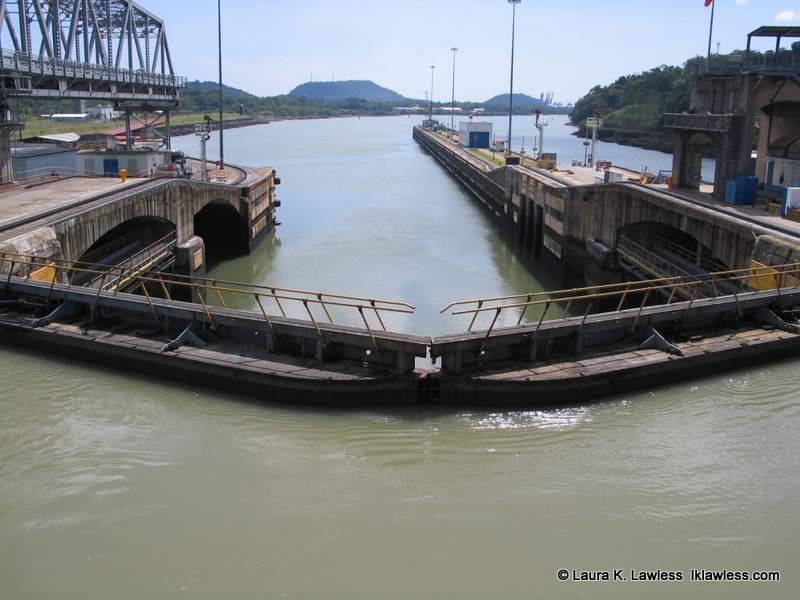 Speaking of which, we did the partial canal cruise – I would have liked to do the full, but it’s only offered twice a month by every single company I checked with, and all pretty much the same days. It’s just as well, as the half day was more than enough. To be honest, I wasn’t all that impressed by the canal. Yes, it’s huge and an amazing feat of engineering and the locks are tremendous, but, well, it’s just not that exciting, you know?
*Upon entering Costa Rica, Americans (I don’t know what it’s like for citizens of other countries) get a stamp in your passport that allows you to stay for three months. You have to leave the country for at least 72 hours to get it renewed, and apparently there are people that have been doing this over and over for years. The government is cracking down a bit though – they say that they start looking at you a little suspiciously the third time you leave and return, but we didn’t have any trouble.
Morocco
I lived in Casablanca, Morocco for exactly 2½ years, from September 2000 to March 2003. My long-time fiancé was teaching English, and I was already a full-time freelancer. After a year, we went up to Gibraltar to get married, in large part because I had to keep leaving the country to renew my visa every three months. We were in Morocco on 9/11, and we left Morocco – coincidentally – the day before the war in Iraq began. (About a month later, several bombs exploded at places we’d been to: a restaurant near our apartment which we loved, and the Spanish cultural center.) Morocco is a beautiful, diverse country filled with extraordinarily generous people.
Costa Rican Weather
We’ve been living on the Pacific Coast of Costa Rica for 7 months now – enough to experience both the rainy (or green) season and the dry season. We arrived in mid-May, and from then until mid-August the weather was perfect: 75-80 degrees, with a few hours of rain at least 3 or 4 times a week (including a number of truly spectacular thunderstorms). In August, it started raining a lot more – in fact, a friend from New York was visiting and unfortunately it rained nearly every day. The moment she left, the skies cleared and the weather was again gorgeous until late September, when it started raining more and more. For about 3 weeks in October, it rained almost non-stop, then it gradually died down. Now, in early December, it’s been dry for a couple of weeks. However, it’s also really hot – 85-90 degrees, and will just keep getting hotter and drier until April.
Plastic is taking over
I guess this is old news, but somehow it completely passed me by. 40% of the world’s oceans is covered in garbage – primarily plastic – concentrated in 5 enormous gyres, or vortexes. I can’t even wrap my head around the staggering amount of garbage this represents. There’s a stretch of land between Casablanca and Rabat, Morocco, that is just covered in plastic bags as far as the eye can see. It’s the place where Plastic Bags Go To Die, or so I thought. Apparently, it’s just a stopover on their way to join their brethren in the oceans.
Plastic bags are absolutely everywhere. In both Morocco and Costa Rica, they’re stacked high in shops, and it’s not uncommon to walk out of a store with $10 worth of groceries in 3 or 4 bags. Even though we bring bags with us, the baggers always seem to be trying to give us more bags, as if to make us feel we got our money’s worth. In the US, the “paper or plastic?” debate was never really resolved. Even our local natural foods store offerred both – though at least they were usually reused.
I don’t know. It’s not as if I have some amazing insights to share on this subject, but I just couldn’t bear to ignore it. Here’s more info, if you’re interested.
The Plastic Sea
Our Oceans Are Turning Into Plastic… Are We?
North Pacific Subtropical Gyre Garbage Map
Eat, Pray, Love, by Elizabeth Gilbert
This book was published in 2006, but I only just got around to reading it, and the only reason I bought it in the first place was that I noticed it on a friend’s bookshelf and liked the cover. I’m amazed that I never heard anyone talking about it, and no one ever recommended it to me, because it’s fantastic. It’s the true story of a woman who spends a year finding herself by eating (and learning Italian) in Italy, praying in India, and loving in Indonesia. It’s funny, it’s touching, it’s inspiring – it’s just a fantastic book. Don’t miss out like I almost did – read